Unlock your dream job with these essential VLSI interview questions. Whether you are preparing for your first VLSI role or aiming to ace advanced interviews, this guide covers everything you need to shine. Get practical tips, answers, and downloadable resources to boost your confidence.
Why Prepare For VLSI Interviews?
Securing a job in the semiconductor industry requires both technical knowledge and clear communication. VLSI interview questions test your understanding of digital circuits, hardware description language, logical gates, timing violation, and more. A solid grasp of basics and smart answer framing make all the difference.
VLSI Basic Interview Questions: Core Concepts
Interviewers often start with basic topics. You may be asked to define what is meant by large scale integration, explain integrated circuits, and describe the difference between combinational circuit and sequential circuit. Don’t forget foundational terms like setup time is the minimum, threshold voltage, and digital electronics.
Examples:
- What is VLSI and why is it important in modern digital circuits?
- Define setup time and hold time in sequential circuits.
- Describe the function of logical gates in integrated circuits.
VLSI Interview Questions and Answers PDF Resource
Many candidates look for vlsi interview questions with answers pdf or vlsi interview questions and answers pdf to simplify preparation. Downloadable PDFs allow easy offline study and help organize answers for tricky hardware description language or field effect transistors questions.
VLSI Interview Questions: Key Technical Areas
Understanding the following high-value technical areas is crucial.
1. Timing Analysis and Violations
- What is positive slack?
It means the data arrives earlier than the required clock edge, ensuring no timing violation. - Explain channel length modulation.
This effect is vital in field effect transistors and impacts threshold voltage stability.
2. Signal Processing and Circuits
- How does the input signal affect circuit performance?
- Describe the differences between synchronous and asynchronous circuits.
- What is the role of the clock signal in timing analysis?
3. Digital Design Principles
- Differentiate between combinational and sequential circuit applications.
- How do logical gates support large scale integration in modern ICs?

VLSI Interview Questions: Frequently Asked
1. What is the significance of threshold voltage in FETs?
Threshold voltage determines the minimum input signal needed for a field effect transistor to conduct.
2. How is timing violation detected in digital circuits?
Timing violations occur when data does not meet required setup or hold times, often exposed during static timing analysis.
3. Explain the impact of channel length modulation.
This phenomenon in field effect transistors leads to variations in drain current and is critical in VLSI.
4. How does clock edge timing affect sequential circuits?
Clock edge ensures synchronization. Any deviation may lead to setup time issues or logic faults.
5. What are the advantages of large scale integration?
Large scale integration enables thousands of transistors in a single chip, allowing powerful, compact digital electronics.
VLSI Interview Questions On Design Verification
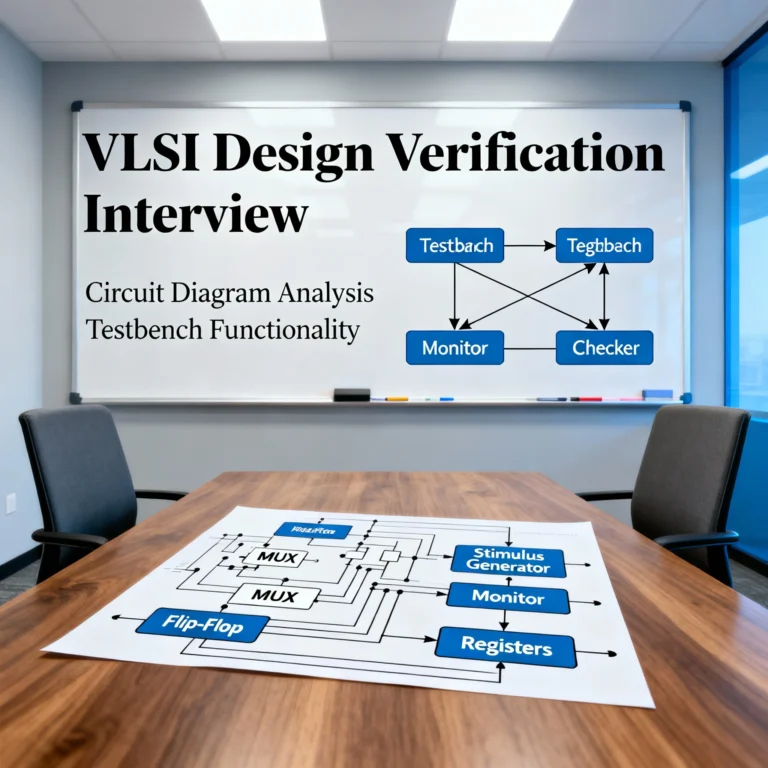
- How do you verify a hardware description language design?
- What steps are essential for finding timing violations using simulation tools?
- Explain functional vs. timing verification in digital circuits.
Advanced VLSI Interview Questions and Answers
- What issues arise from improper clock signal distribution?
Skewed clock signals lead to unreliable sequential circuit operations and potential data corruption. - Why is synchronous circuit design preferred in critical applications?
Synchronous circuits synchronize all operations to a clock signal, reducing timing violation risk.
VLSI Interview Questions For Freshers
- What distinguishes combinational circuit from a sequential circuit?
- How does setup time impact performance?
- List common logical gates and their functions.
Preparing for interviews on-the-go? Download vlsi interview questions with answers pdf or vlsi interview questions and answers pdf from leading educational platforms or from your university resources for structured revision. Ensure these resources cover topics like digital circuits, setup time, threshold voltage, timing violation, and large scale integration.
Tips for Acing VLSI Interview Questions
- Master both basic and advanced concepts (e.g., integrated circuits, channel length modulation).
- Practice answering typical interview questions and answers out loud.
- Be ready to give real-world examples from digital electronics projects.
- Download and review vlsi interview questions with answers pdf for rapid last-minute revisions.
How to prepare for a VLSI interview?
Here’s a simple and short guide to prepare for a VLSI interview:
- Basics: Revise Digital Electronics (logic gates, flip-flops, FSMs, timing diagrams).HDL: Practice Verilog/VHDL coding — combinational & sequential circuits.
- Synthesis & STA: Understand RTL to gate-level flow, setup/hold time, timing closure.
- Physical Design: Learn placement, routing, clock tree, and power analysis basics.
- Tools: Be familiar with Synopsys, Cadence, or Mentor tools (at least conceptually).
- Projects: Be ready to explain your VLSI projects — flow, tools used, results.
- Aptitude & Debugging: Practice basic problem-solving and code debugging.
- HR Round: Prepare to talk about your strengths, teamwork, and learning mindset.
What are the 5 star interview questions?
1.Tell me about a time you solved a problem.
Situation: In college, my project had a timing issue.
Task: I had to find and fix the delay.
Action: I checked the timing paths and optimized the logic.
Result: The design met timing and worked perfectly.
2.Describe a time you worked in a team.
Situation: We were designing a VLSI mini-project.
Task: My job was to write the Verilog code.
Action: I coordinated with others for testing.
Result: We finished early and got good feedback.
3.Tell me about a challenge you faced and how you handled it.
Situation: The synthesis tool kept showing errors.
Task: I had to fix them before submission.
Action: I searched documentation and discussed with seniors.
Result: Errors were cleared and the design ran fine.
4.Give an example of when you learned something new quickly.
Situation: I had to learn timing analysis for my internship.
Task: I needed to use PrimeTime software.
Action: I watched tutorials and practiced.
Result: I learned it in a week and used it successfully.
5.Describe a time you showed leadership.
Situation: Our project team was behind schedule.
Task: I helped plan and divide the work.
Action: I motivated teammates and tracked progress.
Result: We completed the project on time.
Is VLSI easy or difficult?
VLSI can be both easy and difficult, depending on your interest and practice.
- It’s easy if you enjoy electronics, logic design, and coding.
- It’s difficult if you skip the basics or don’t practice hands-on tools.
How to Crack VLSI Job Interviews: Common Questions & Tips
Common Questions:
- Basics of digital electronics (flip-flops, mux, counters, FSMs).
- Verilog/VHDL coding and debugging.
- Synthesis and timing (setup, hold, slack).
- Physical design flow (placement, routing, CTS).
- Project-based questions (tools used, your role, challenges).
- Basic CMOS concepts (inverter, delay, power).
Tips to Crack the Interview:
- Revise fundamentals before the interview.
- Practice HDL coding regularly.
- Understand your project deeply — be ready to explain it clearly.
- Learn key EDA tools and their purpose.
- Stay calm and think logically when solving questions.
- Show interest in learning and problem-solving.
- 👉 In short: Strong basics + hands-on practice + confidence = success in a VLSI interview.
What is VLSI and its types?
VLSI (Very Large Scale Integration) means putting millions of transistors on a single chip to make complex circuits like processors and memory.
Simple Definition:
VLSI is the process of designing and fabricating integrated circuits (ICs) that contain many logic gates and components on one chip.
Types of VLSI Design:
Digital VLSI Design – Focuses on digital circuits (e.g., processors, controllers).
Analog VLSI Design – Deals with amplifiers, filters, and signal processing.
Mixed-Signal VLSI Design – Combines digital and analog parts (e.g., ADC, DAC).
RF VLSI Design – Used for wireless and communication systems.
Memory Design – Focuses on SRAM, DRAM, and Flash memory chips.
👉 In short:
VLSI is about creating smart chips used in mobiles, computers, and all modern electronic devices.
About the Author